



Mt. Jiri is the most famous in Korea. It has many historic stories, sites and temples. Especially the scenery on mountaintop is very wonderful and beautiful.
| Invited Talk | |
|
|
|

 Kari
Pulli (Nokia Research Center)
Kari
Pulli (Nokia Research Center)
"Mobile Visual Computing"
[abstract] In this talk, I will talk about camera phones, how you can use camera as a sensor that gives natural access to the information about the real world around you (mobile augmented reality) and how you can combine general computation capability to combine several input images into better or more interesting output images (mobile computational photography). I will also discuss about mobile graphics and the latest development on the HW and APIs (OpenGL ES, OpenMAX IL, OpenCL) that allow using graphics HW for these applications.
*****
Kari Pulli is a research fellow at Nokia Research Center.
He has been an active contributor to several mobile graphics standards and
recently wrote a book about mobile 3D graphics.
Pulli received a PhD in computer
science from the University of Washington and an MBA from the University of
Oulu.
(http://research.nokia.com/people/kari_pulli/)
 Daniel
Wagner (Technische Universitaet Graz)
Daniel
Wagner (Technische Universitaet Graz)
"Augmented Reality on Mobile Phones"
[abstract] Research on Augmented Reality (AR) on mobile phones has begun around 5 years ago. In the last two years the technology has matured enough to raise a strong interest from commercial sides. In this talk I am going to give an overview of the current state of the art in AR on phones, what works and what doesn't. I will discuss current problems, solutions and future trends and outline the AR point of view of upcoming mobile phone hardware.
*****
Daniel Wagner is a postdoctoral researcher at Graz University of Technology. He received his MSc from Vienna University of Technology and his PhD from Graz University of Technology.
During his studies he worked as a software developer and joined Reality2, developing Virtual Reality software. After finishing his Computer Science studies, Daniel was lead developer at Vienna based game company BinaryBee, working on high-quality multi-user internet games, as a software developer for Tisc Media, doing 3D engine development for a TV-show game, and as a consultant for Greentube’s "Ski Challenge ’05".
In 2006 he was a visiting researcher at HITLab New Zealand.
In October 2007 Daniel finished his PhD thesis on PhD thesis on Handheld Augmented Reality.
Daniel’s current interest as a researcher at Graz University of Technology is on mobile Augmented Reality technology. His current research interests are real-time graphics and computer vision for mobile phones.
(http://www.icg.tu-graz.ac.at/Members/daniel)
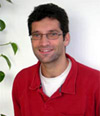 Antonio
Krüger (Institute for Geoinformatics University of Muenster)
Antonio
Krüger (Institute for Geoinformatics University of Muenster)
"Assistive Technologies in Instrumented Spaces"
[abstract] This talk will investigate the design of systems which intelligently support users in a ubiquitous computing environment. The focus lies on novel human computer interaction paradigms which act as a bridge between the real and the digital world. The talk discusses the way how the design and the implementation of these interaction paradigms can be informed by intelligent technologies and usability studies.
After an investigation of the advantages and drawbacks of several deployed research prototypes from the areas of mobile embedded interaction, public advertising, spatial navigation, and interactivee surfaces, the talk will present novel interaction patterns based on AI and user-centered design methods.
*****
Antonio Krüger is a professor of geoinformatics and computer science at the University of Muenster, Germany.
His research interests include intelligent user interfaces, and generation processes and human–computer interaction with limited technical and cognitive resources.
Krüger received a PhD in computer science from Saarland University.
(http://ifgiweb.uni-muenster.de/~kruegera/)
4
 Bruce Hunter Thomas (University of South Australia)
"Supporting User Interfaces in Ubiquitous Vortual Reality"
[abstract] Ubiquitous Virtual Reality focuses on the widespread access of digital information to the user with the fusion and extension of a number of computer science disciplines. A number of these domains currently have a desperate set of display and interaction technologies of their own. These domains cover a wide range of research topics, such as the following: virtual reality, mixed reality, augmented reality, wearable computing, pervasive computing, ubiquitous computing, haptic interfaces, mobile context-aware computing, emotional affective agents, sensors, intelligent systems, and computer graphics. This talk will focus on ways users can conveniently and easily transfer between these different modes of interacting with digital information. Each of these domains has a particular display and interaction technologies that current support their form of information presentation. In additional these domains have software and metaphor support for their user interfaces. This talk will focus on methodologies to perform a number of tasks:
1. transitions between different presentations of information,
2. unifying technologies to better bring together these domains, and
3. articulate the important aspects of interactions within a Ubiquitous Virtual Reality system.
This talk will explore a number of possible technologies, such as input devices, clipboard technologies, and software frameworks. The talk will also highlight areas that need future exploration and possible pitfalls to avoid.
*****
Professor Thomas is the current the Director of the Wearable Computer Laboratory at the University of South Australia. He is currently a NICTA Fellow, CTO A-Rage Pty Ltd, and visiting Scholar with the Human Interaction Technology Laboratory, University of Washington.
Prof. Thomas is the inventor of the first outdoor augmented reality game ARQuake.
His current research interests include: wearable computers, user interfaces, augmented reality, virtual reality, CSCW, and tabletop display interfaces.
(http://www.unisanet.unisa.edu.au/staff/Homepage.asp?Name=bruce.thomas)
Culture Technology Institute(CTI), Gwangju Intitute of Science and Technology(GIST)
261 Cheomdan-gwagi-ro(Oryong-dong), Buk-gu, Gwangju 500-712, Korea